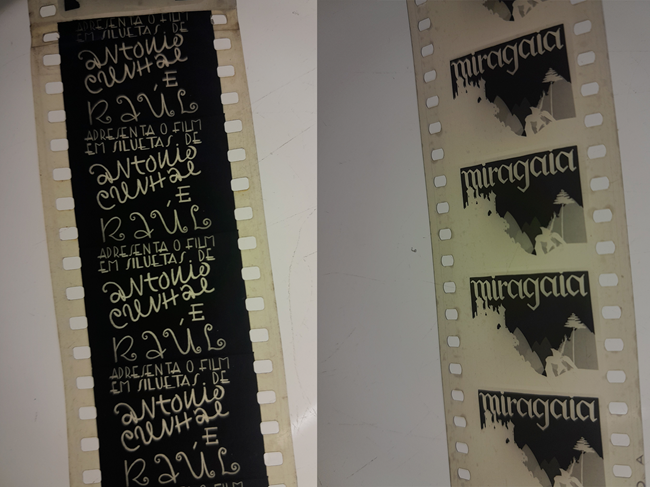
At the beginning of last week week, in an official statement, the Portuguese Cinematheque – Museum of Cinema announced the unexpected recovery of the Portuguese film “The Legend of Miragaia” (“A Lenda de Miragaia”; Raul Faria da Fonseca & António Cunhal, 1931), which had previously been considered lost.
This is excellent news, not only because any opportunity to recover, safeguard and preserve cultural heritage is always welcomed, but also because this is one of the earliest animated films produced in Portugal, created using the silhouette animation technique. Furthermore, this cinematic work forms part of an important body of films produced in Portugal that portray the Middle Ages. The film tells the story of the “Legend of Miragaia”, also known as the “Legend of Gaia” or the “Legend of Ramiro”, recounting the adventures and tribulations of King Ramiro II of León (898–951) in the territory corresponding to present-day northern Portugal during the tenth century. It is one of the most significant narratives of the Portuguese Romanceiro tradition and was immortalised in the nineteenth century through the famous narrative poem by Almeida Garrett, first published in 1843 in the Jornal de Bellas-Artes.

The production of this film, which turned to a legendary medieval past in the early 1930s, can be analysed alongside other films such as “Queen After Death” (“Rainha depois de Morta”; Carlos Santos, 1910) and “The Dance of Paroxysms” (“A Dança dos Paroxismos”; Jorge Brum do Canto, 1930). Together, these works demonstrate the interest that medieval themes have inspired within Portuguese cinema since its earliest years. Research into the representation of the Middle Ages in cinema is, in fact, one of the lines of inquiry pursued by an interdisciplinary research group led by Alicia Miguélez (IEM), which brings together researchers from IELT, IFILNOVA and IHC at NOVA FCSH, from CH at the Faculty of Arts of the University of Lisbon (FLUL), and from other international academic institutions. In recent years, this group organised the film series Luz e Sombra. A representação da Idade Média no cinema (Light and Shadow: The Representation of the Middle Ages in Cinema), first held in Lisbon in collaboration with the Portuguese Cinematheque – Museum of Cinema (2022), and subsequently in Madrid in collaboration with the Spanish Film Archive (Filmoteca Española) and the Círculo de Bellas Artes (2023–24). The group also published the volume La Edad Media proyectada. El pasado medieval ibérico en la creación audiovisual en lenguas portuguesa y española, edited by Alicia Miguélez, Erika Loic and Felipe Brandi (Madrid: Iberoamericana Vervuert, 2025). The book was officially launched on 30 May at an event held at the Portuguese Cinematheque – Museum of Cinema, organised in partnership with the Linha de Sombra Bookshop, where it is currently available for purchase.
The news of the recovery of The Legend of Miragaia is therefore welcomed with great enthusiasm and serves as further motivation to continue producing new knowledge on the reception and uses of the Middle Ages in the contemporary world, while sharing that knowledge with society as a whole.